Live business advisors standing by Toll Free
 888-893-2993 (M-F, 7AM - 4PM PST)
Schedule a demonstration of how to automate your prospecting
Schedule Now
Live business advisors standing by Toll Free
888-893-2993 (M-F, 7AM - 4PM PST)
Schedule a demonstration of how to automate your prospecting
Schedule Now
Last Updated: September 24, 2026
When comparing everquote vs policyprofile, both dominate the insurance lead marketplace, but they work differently and suit different agency types.
EverQuote operates as a high-volume shared lead marketplace where multiple agents bid for the same prospect. PolicyProfile positions itself as an exclusive lead provider. The question is which model works for your agency.
EverQuote generates thousands of insurance quotes daily through its consumer-facing website and advertising network, delivering leads within minutes.
Those leads go to multiple agents simultaneously. Agents report closing rates between 3-8%, depending on follow-up speed and qualification quality. The first agent to reach the lead typically wins.
PolicyProfile distributes leads on a first-come, first-served basis within territories to fewer agents. Agents typically report conversion rates in the 5-12% range, varying by agent skill and territory saturation.
Both platforms’ conversion rates depend more on follow-up speed and qualification than the platform itself. Agents calling within 2 minutes close at 2-3x the rate of those waiting 15 minutes.
Conversion rate alone doesn’t indicate profitability. A 6% close rate on cheap leads may generate more commission than a 10% close rate on expensive leads. The real metric is revenue per lead spent.
This is where the platforms differ most dramatically.
Shared leads (EverQuote model): You receive a lead, and so do 3-8 other agents. Speed to contact is everything. Pros: cheap leads, volume control, massive prospect pool. Cons: price/speed competition, compressed margins, prospects expect multiple quotes.
Exclusive leads (PolicyProfile model): A lead is assigned to you and a few other agents in your zip code. Pros: less price competition, focus on value over speed, longer sales cycles possible, healthier margins. Cons: depend on territory assignment, fewer leads if demand is low, quality varies by targeting.
Exclusive leads feel better in theory, but shared leads often generate more total revenue. A 4% close rate on 100 leads beats a 10% close rate on 10 leads.
For agents in the 50+ retirement market with 4-8 week sales cycles, exclusive models work better. You need time to educate prospects about annuities, long-term care insurance, and IRA rollovers.
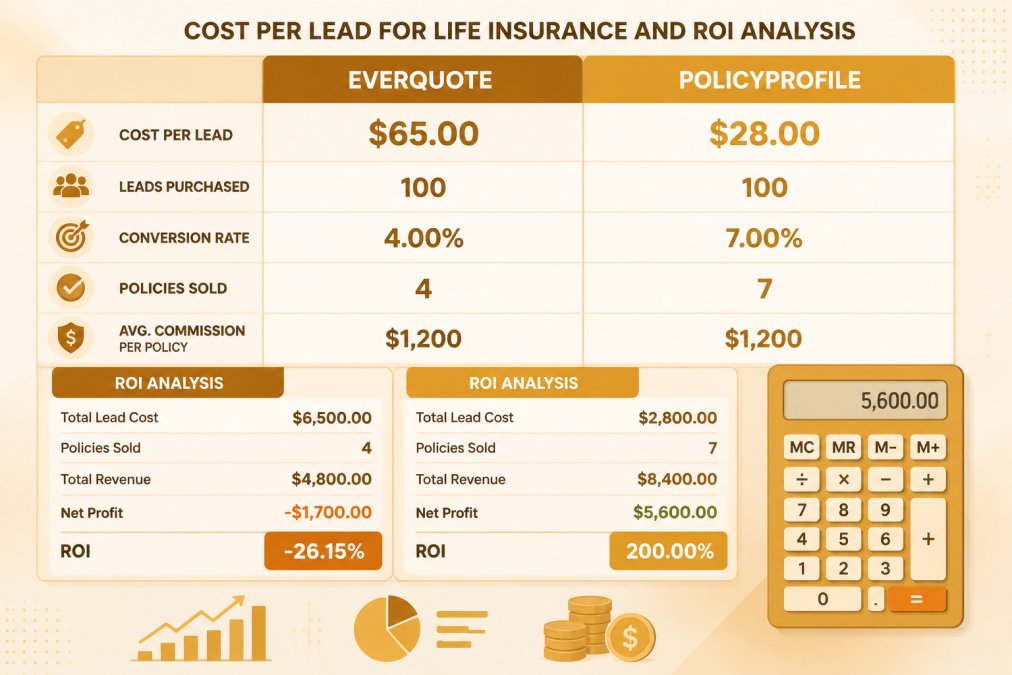
Both platforms are transparent about per-lead costs, but most agents calculate ROI incorrectly, comparing cost per lead instead of cost per close.
EverQuote’s Auction-Based Pricing Model:
EverQuote operates on real-time bidding. Costs vary by product type (term life $8-18, whole life $15-30), age bracket (under 35: $5-12, 50+: $20-35), location (urban 40-60% higher), seasonality (Q4 +30-50%, Jan-Feb -20-30%), and health profile (healthier prospects cost more).
PolicyProfile’s Flat-Rate Territory Model:
PolicyProfile charges a flat monthly rate based on territory and expected volume: $2,000-3,000/month for mid-sized metros, $4,000-6,000/month for large metros, $800-1,500/month for rural territories.
Cost Per Close: The Real Metric:
Here’s where most agents make mistakes. They compare cost per lead ($15 on EverQuote vs. $40/month on PolicyProfile) without calculating cost per close.
Cost per close = (Total platform cost) / (Number of closes)
Scenario 1: Solo Agent, Suburban Market
EverQuote: 50 leads/month at $14 = $700/month, 4% conversion = 2 closes, $350 cost per close, $100 profit per close, $200 monthly profit.
PolicyProfile: $2,000/month flat, 7% conversion = 3-4 closes, $500-667 cost per close, -$50 to -$217 profit per close.
EverQuote wins. Solo agents lack volume to justify PolicyProfile’s flat fee.
Scenario 2: Team of 5 Agents, Urban Market
EverQuote: 300 leads/month at $18 = $5,400/month, 5% conversion = 15 closes, $360 cost per close, $140 profit per close, $2,100 monthly profit.
PolicyProfile: $5,000/month flat, 8% conversion = 20-25 closes, $200-250 cost per close, $250-300 profit per close, $5,000-7,500 monthly profit.
PolicyProfile wins. Teams generate enough volume to justify the flat fee and achieve lower cost per close.
The Hybrid Model: Best of Both Worlds
Agencies with 10+ agents typically run both platforms: EverQuote (400-500 leads/month at $16 = $6,400-8,000/month) + PolicyProfile ($5,000-8,000/month) = $11,400-16,000/month total cost, 40-50 closes/month, $228-400 cost per close, $12,000-20,000 monthly profit. The hybrid model works because EverQuote provides cheap volume, PolicyProfile provides high-margin exclusive deals, and you’re not dependent on a single platform.
Hidden Costs You’re Not Accounting For:
Hidden costs beyond per-lead fees include CRM automation ($50-150/month), TCPA compliance ($30-100/month), phone/dialer systems ($100-300/month), and agent training ($1,200-4,000 per agent). These add $200-500/month to total platform cost.
Benchmarking Your Performance:
ROI benchmarks: EverQuote cost per close should be $250-350 (not above $400). PolicyProfile should be $300-450 (not above $600). Hybrid blended should be under $350. If above benchmarks, the issue is usually follow-up speed, lead qualification, or sales skill, not the platform.
Seasonal Cost Adjustments:
Smart agents adjust spending seasonally: Q4 increase EverQuote 20-30% (higher costs, faster closes), maintain/reduce PolicyProfile. Q1 reduce EverQuote 20-30%, increase PolicyProfile (New Year’s resolutions). Q2-Q3 run steady budgets. Seasonal adjustments yield 15-25% better ROI than flat budgets.
Integration depth and speed directly impact cost per close. A lead sitting in a queue for 15 minutes while syncing to your CRM is already lost on a shared platform.
EverQuote’s Technical Integration:
EverQuote offers native API connections to HubSpot, Salesforce, Pipedrive, and Zoho with 60-90 second lead sync and webhook triggers for SMS alerts, task creation, and routing. The bottleneck is your team’s response time. Manual lead checking adds 5-10 minutes of latency, costing conversions. Lead routing rules prevent leads from sitting unassigned.
PolicyProfile’s Integration Approach:
PolicyProfile’s integration is less standardized, requiring manual CSV import or Zapier for some CRMs. The longer window (24 hours) is acceptable since prospects aren’t getting multiple calls. However, in hybrid models, manual import becomes a bottleneck, invest in Zapier or Make to consolidate multiple lead sources.
Automation and Workflow Efficiency:
Automation setup drives competitive advantage. Agents implementing auto-dialer integration, SMS trigger sequences, lead scoring rules, and task assignment logic see 20-30% higher conversion rates on shared leads.
Integration Costs and Setup Time:
Native integrations (EverQuote to Salesforce, for example) are free and take 30-60 minutes to configure. Third-party automation tools like Zapier cost $20-100/month depending on the number of tasks and lead volume. If you’re running a hybrid model with 5+ lead sources, expect to spend $50-150/month on automation tools.
The ROI is clear: a 2-minute faster response time on 50 leads per month could generate 2-3 additional closes. At $400-600 per commission, that’s $800-1,800 in extra revenue per month, far more than the cost of automation tools.
Data Mapping and Field Consistency:
One often-overlooked integration issue: field mapping. EverQuote sends lead data with specific field names (e.g., “phone_number”, “date_of_birth”). Your CRM might use different field names (“Phone”, “DOB”). If these don’t map correctly, your automation breaks. Leads arrive without phone numbers, and your auto-dialer can’t function.
Both platforms provide field mapping documentation, but you need to verify it matches your CRM’s schema before going live. A 30-minute audit of field mapping can prevent weeks of leads flowing into your CRM with missing critical data.
Compliance and Data Security:
Both EverQuote and PolicyProfile comply with TCPA (Telephone Consumer Protection Act) requirements and maintain SOC 2 certifications. However, your CRM integration must also be TCPA-compliant. If you’re using a third-party automation tool to sync leads, verify that tool is also compliant.
“Hi [Name], I’m [Agent Name] with [Company]. I see you requested a life insurance quote. Before you compare rates, I want to make sure we’re looking at the right coverage type for your situation. Do you have 10 minutes?”
“Hi [Name], I’m [Agent Name]. I noticed you were interested in life insurance. I work with a lot of clients in your situation, [specific situation]. I’d love to understand your goals before we talk rates. When’s a good time?”
For solo agents or teams under 5 people: PolicyProfile often makes more sense. Exclusive leads reduce the pressure to be fastest. You can focus on quality conversations instead of racing against other agents. Your lower volume is actually an advantage because you can give each prospect proper attention.
EverQuote and PolicyProfile both work, they just work for different agents and different sales models. EverQuote wins if you need volume, have fast follow-up systems, and can compete on speed and price. PolicyProfile wins if you need exclusivity, work with longer sales cycles, and focus on relationship-based selling.
No. Both platforms typically distribute shared leads to multiple agents in the same geographic area. This means you’re competing with other agents for the same prospect. Exclusive leads, where only you receive a specific prospect in your zip code, are available through specialized platforms but usually cost more per lead. Understanding this distinction is critical when calculating your actual conversion rate and ROI.
Pricing varies significantly based on lead type, geographic area, and volume. Both EverQuote and PolicyProfile operate on pay-per-lead models, but actual costs depend on whether leads are shared or exclusive, the demographic quality, and your negotiated rates. Contact each platform directly for current pricing quotes tailored to your target market, as rates fluctuate based on demand and lead sourcing costs.
Speed to lead is critical. With shared leads, the first agent to contact typically converts the highest percentage. Most successful agents aim to reach prospects within 5-15 minutes of receiving the lead. Having insurance agent lead follow-up scripts prepared and using auto-dialer technology can dramatically improve your contact ratio and conversion rates compared to manual outreach.
PolicyProfile may be suitable for smaller operations. EverQuote’s larger lead volume may be suitable for teams with dedicated sales staff but can overwhelm solo advisors without proper lead management systems. Evaluate your current team capacity, CRM integration capabilities, and daily lead-handling bandwidth before committing.